Who did invent the telephone?
There is some question over who really invented the telephone. There were several people around the world working on the telegraph technology, hoping to improve it. Some were trying to send multiple messages along one line, some were trying to send sounds, and some were trying to transmit voices and real world noise. The niceties of the timing of the Alec Bell & Elisha Grey patents, and the sterling (prior) work of Antonio Meucci create a popular argument about who should be credited as THE inventor. There is even a great Wikipedia article on the subject, Invention of the telephone - Wikipedia.
Each inventor has their proponents ready to argue the “facts” to suit their favourite history. The interesting question behind this is “ How come so many people were inventing the telephone at the same time?”
With the benefit of 20/20 hindsight we can see a progression of electrical discoveries, each building on the work of before.
Luigi Galvani found frog-leg jumping electricity c.1780
Humphry Davy discovered the presence of electrical charges and action in chemistry c.1806
In the same room, the baton was passed to Michael Faraday who went on to discover the electro-magnetic world c.1812
Hans Christian Orsted found that electric currents could create magnetism, c.1820
William Sturgeon invented the electro-magnet c.1824
The electrical relay created by Joseph Henry & Edward Davy allowed electrical charge to be sent over longer distances, c. 1835
Several inventors tried turning this technology into a long-distance communication tool, but Samuel Morse is credited with inventing a telegraph and crucially making it accessible, c.1837
The telegraph changed the world. Cables were laid everywhere.
Cable from England to France, 1850
Across the Atlantic (after several false starts), 1866
To Australia, 1872
All the smart money went into telegraphy and inventions concentrated on improving the telegraph. In 1876, there were still patents being made to improve telegraph equipment. Charlie Lewis, the shop foreman at Western Union was awarded patent no 177,856 for his Lewis Key which was really just a more stable piece of kit on the table top. It was a useful modification but not really a new invention.
It is clear that Gray, Meucci and Bell were all working on sound transmission. It was definitely Bell who successfully sent voice across the wire. Whether he was the first or not, it was the time for someone to invent telephony.
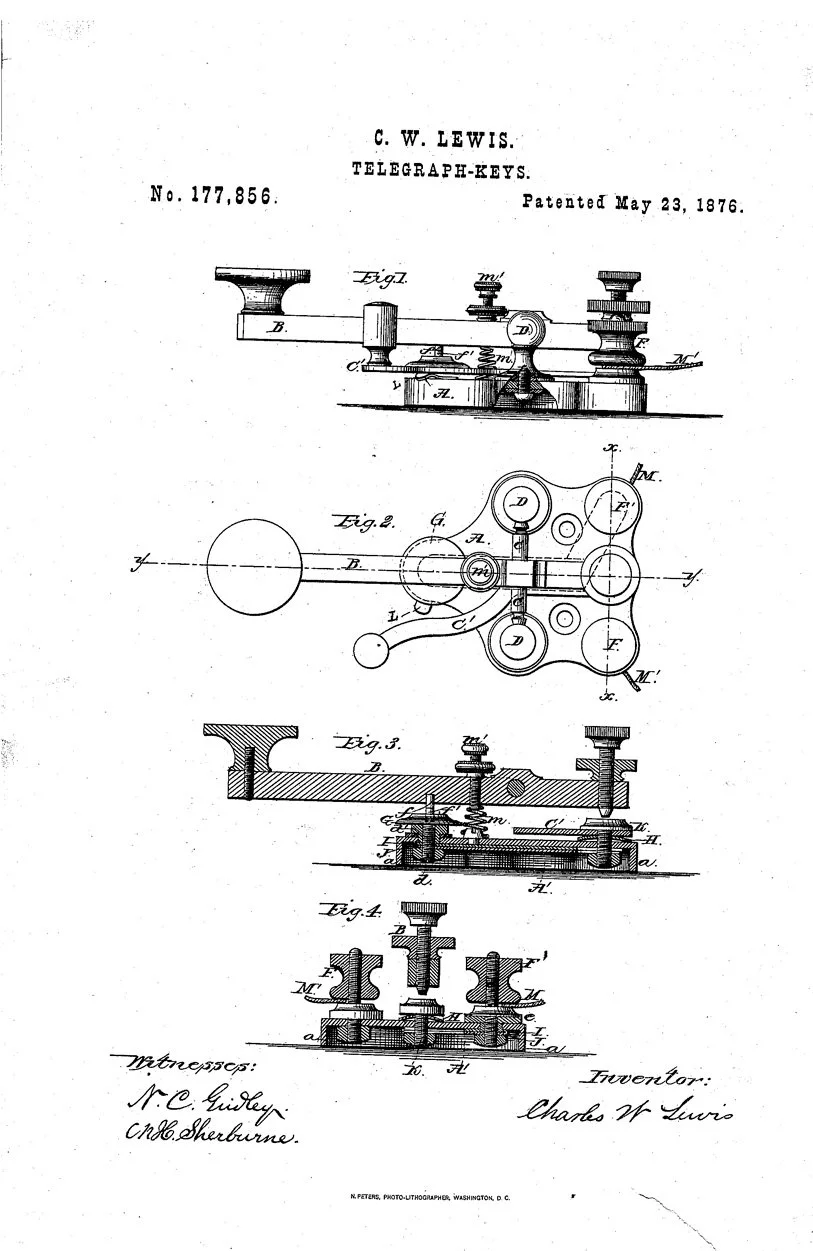
Patent No 177,856 of 23 May 1875 by CW Lewis for improvements to Telegraph Keys
From 1870 the Edison invention machine had been working hard at automatic telegraphy. Instead of an operator tapping out a message one dot or dash at a time wouldn’t it be better to have a machine that whizzed the right dots and dashes along the telegraph wire faster and more accurately, leaving the line free for more and more conversations? Ingenious ideas of creating dots and dashes on rolls of punched tape that sent variable signals in the same pattern as morse code were tried with just as ingenious ideas for operating a stylus at the other end to write them down.
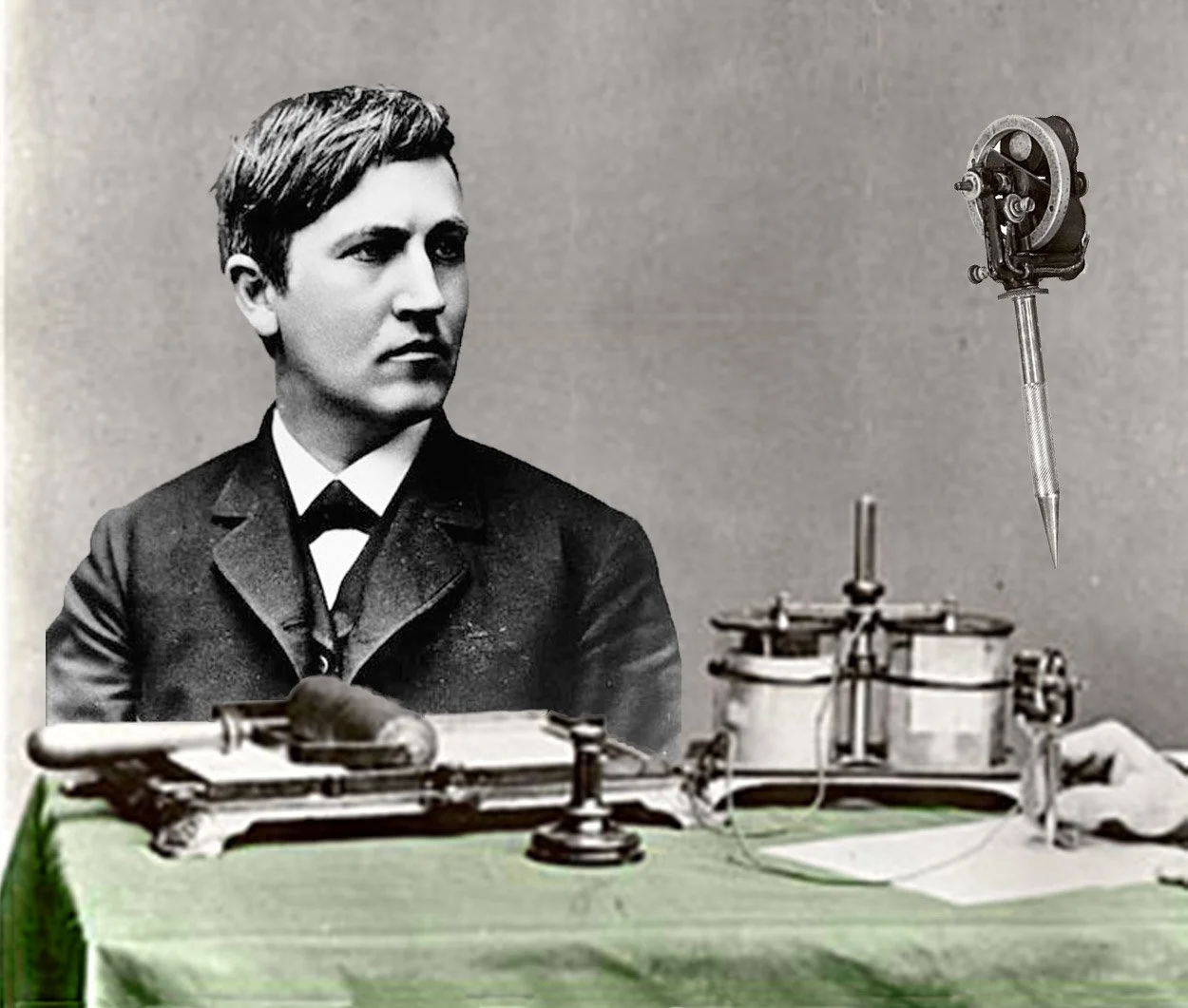
There was a rash of Edison patents in 1876 for automatic telegraphs, duplex telegraphs, chemical telegraphs, acoustic electric telegraphs and even electro-harmonic multiplex telegraphs. Here he is with his 1876 electric pen & motor.
But while all the smart money was on telegraphy, Antonio Meucci was working on his Sound Telegraph, Alec Bell was trying to invent something to get on the right side of young & deaf Mable Hubbard’s father, and Elisha Grey was trying to send musical tones down a telegraph wire.
It was time for someone to invent the Vibrophone (as Bell almost called his version of the invention). His was arguably the most practical solution and he certainly pressed it forwards through more research & development. In March 1876 he made the first phone call - a short distance from upstairs to one floor below, 5 months later had managed a long distance call (10 miles), and just 2 months after that had developed a 2-way conversation down one line.
“If I have seen further it is by standing on the shoulders of giants” wrote Isaac Newton to Robert Hooke in 1675 England (a little after the Civil War). The same synchronicity appears with other inventions whose time has come, eg television, telegraph.
While the world was improving telegraphs, visionaries were creating telephones. And while there is now massive investment in newer, faster, brighter, shinier, smarter phones (or watches or glasses), there is probably research going on right now into telepathy transceivers that will make the whole lot redundant and one industry will collapse while another takes over. I’m looking forward to getting more memory fitted into my skull …