Why bananas in 1876?
Bananas have been around, well, for-almost-ever. You can find their origins in Indonesia, their migrations, and their cultivation across the tropics. Over thousands of years, humans have selected banana species until we now have the sweeter dessert banana and its savoury cousin, plantain. The banana thrives in a tropical environment, and it spread west from Indonesia, through India and Africa, and then on to the Caribbean and Central America.
Bananas spoil relatively quickly after being picked and so they stayed near to these tropical lands. As boat technology improved, the bananas could be transported further before spoiling. There is a story that in 1804 a schooner, Reynard, brought 30 bunches of bananas from Cuba to New York, but no record if they were edible.
In June 1870, Captain Lorenzo Baker took 13 days to transport 160 stems of bananas from Jamaica up to Jersey City. On his journey back to the Caribbean he exported flour, pork, salted cod, cotton prints and other “Yankee notions”. This was the start of the Boston Fruit Company. They bought land for plantations in Jamaica and the banana trade was up and running.
Banana imports into New York in 1871 were valued at $232,986. By the next year the trade had more than doubled and over 400,000 bananas travelled to New York, bringing in tariff revenues of 10%, over $50,000.
1873’s imports did not have any tariff tax attached:
A typo in the regulations excluded “fruit, plants”, instead of “fruit-plants” and the US Revenue service was unable to charge tariffs on many fruit imports, such as grapes, lemons and oranges. Importers litigated to remove the then 20% tariff and saved themselves a reported $2 million which therefore did not go to help the Grant government.
Red bananas were very popular at the time, imported from Cuba. Today, around 20 million (mostly yellow) bananas travel to New York City each week.
In 1876, bananas made their appearance at the Centennial Exposition in Philadelphia. This World’s Fair was to celebrate the 100 year birthday of the United States of America, marred only slightly by a few years when some disunited States formed their breakaway Confederacy. A banana tree was on display in one of the many massive exhibition halls, though not to everyone’s enthusiasm.
“The Horticultural Hall is one of the building which are to remain, and its lovely architecture, in which the light arabesque forms express themselves in material of charming colors, merits permanence. It is extremely pleasing, and is chiefly pleasing as architecture for the show of plants is not very striking to the unbotanized observer, who soon wearies of palms and cactuses and unattainable bananas, and who may not have an abiding joy in an organ played by electricity, with a full orchestral accompaniment similarly operated.” -
“A Sennight of the Centennial” by William Dean Howells; Atlantic Monthly (July 1876)
Though the banana did impress some.
“I retain a fairly vivid recollection of eating my first banana. It was in 1876, and I, then a youngster, was visiting the Centennial Exposition in Philadelphia with my father as guide and treasurer. We had visited the horticultural department and there was then pointed out to me one of the leading attractions of that exhibit, a scrubby banana tree from beneath whose fronds actually grew a diminutive bunch of bananas. To my young and impressionable mind this was the most romantic of all the innumberable things I had seen in any of the vast buildings. On the very same evening we took a long walk along one fo the business streets of Philadelphia. My father was fond of fruiots, and he paused at a store, about to buy some peaches, when his attention was diverted to a basket containing small cylindrical objects wrapped in tin foil. ‘What are those?’ he asked of the clerk. ‘Bananas’ proudly replied the salesman. ‘Bananas just imported from South America. They are a great luxury, sir, and this is the only pace in Philadelphia which handles them.’
‘Bananas in tin foil! I presume most of your customers think they grow that way?’
’They are a novelty sir, and only our best customers call for them. May I wrap up some for you?’
’How much are they?’
’Ten cents apiece, or six for half a dollar.’
’That is more money than the native who raised them could earn in a month. I will take a half a dollar’s worth.’
“Back in the room in our hotel I stripped the tin foil from one of them and revealed a substance that looked like the bananas I had seen that afternoon, save that this one was nearly black and the growing ones were green. I was about to bite into the skin when my father interfered and removed the peel, looked at the interior critically and rather doubtfully, tasted it and gave it to me.”
‘It is not ery good, but it is a banana. How do you like it?’
“I assured him that it was delicious, but I presume that the novelty of the thing gave my taste a zest and the fruit a flavor not justified by its condition. Two of the six bananas were in such an advanced stage of decay that they were rejected, but we shared the others. They were small bananas, and it would have taken three of them to make the bulk of one of the delicious yellow bananas now at the cheap command of practically every consumer in the United States. Thus in 1876 we paid about twnty times the present retail price of bananas. The bananas which we bought and ate as a curiosity would now be condemned by the first food inspector who took a glance at them, but I suffered no harm and fell into pleasant dreams of tropics.”
”Conquest of the Tropics” by Frederick Upham Adams (1914)
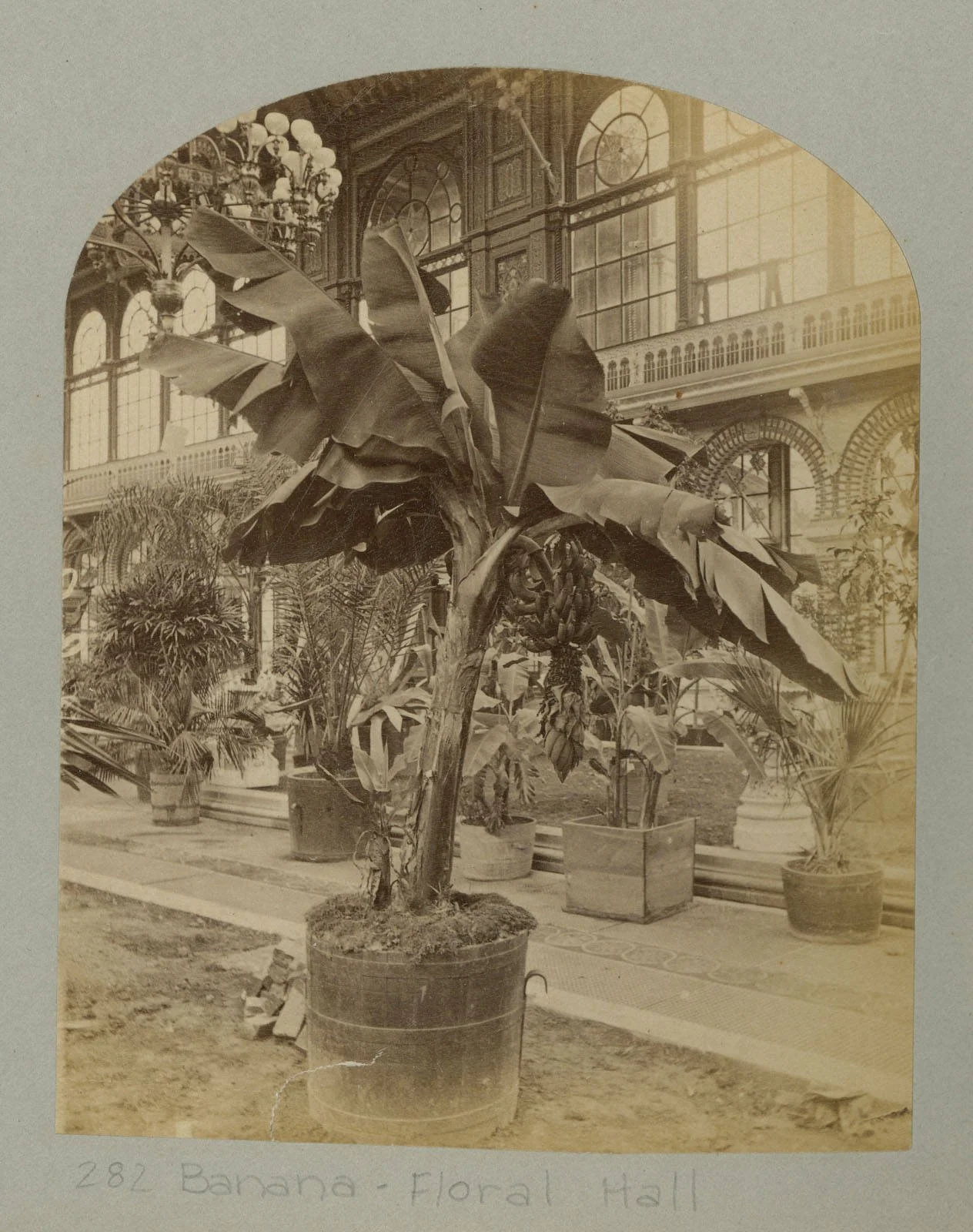
Banana tree in the Hoticultural Hall, Floral Hall, at the Centennial Exposition, Philadelphia 1876
References:
Combining Biological Approaches to Shed Light on the Evolution of Edible Bananas by Xavier Perrier - Ethnobotany Research and Applications Journal Vol 7 (2009) https://ethnobotanyjournal.org/index.php/era/article/view/362
The History of the American Fruit Industry in the Caribbean, a Thesis by Oliver Eller Irons (June 1929)
https://scholarlycommons.pacific.edu/context/uop_etds/article/1885/viewcontent/Irons__Oliver_Eller___June_1929.pdf
The Secret Life of the City Banana, New York Times
https://www.nytimes.com/2017/08/04/nyregion/the-secret-life-of-the-banana.html
In 1876: Bananas & Custer by Rob Cormican (2014)
”Conquest of the Tropics” by Frederick Upham Adams (1914) Pg 20-3
https://archive.org/details/conquestoftropic00adamiala/page/20/mode/2up
An Act to Reduce Duties on Imports, and to Reduce Internal Taxes, and for Other Purposes
42nd Congress; Session II; Chapter 315 (1872); US Statutes at Large Volume 17, Pg 235
The Most Expensive Typo in Legislative History; Priceenomics (2014)
https://priceonomics.com/the-most-expensive-typo-in-legislative-history/